

Homeopathy is a system of medicine that uses highly diluted substances, traditionally used to work with the body's natural response to everyday discomfort. Many people search for homeopathic options because they want a non-opioid, alcohol-free approach to the temporary relief of pain and inflammation.
This guide explains how homeopathic remedies are selected for different types of pain, which common remedies are traditionally used for, how U.S. regulation works, and what to look for in a specific OTC product.
The information here is educational and written in plain English. It covers the foundational ideas behind homeopathic pain care, so you can make a more informed choice. If you want to explore a specific, FDA-NDC-listed homeopathic option, you can visit Blue Scorpion to see how it fits into homeopathic pain care.
How Homeopathic Pain Selection Works
In homeopathy, pain is not treated as a single category. The sensation, timing, and triggers all matter when choosing a remedy. Acute discomfort and ongoing patterns are handled differently.
Matching the Remedy to the Type of Pain
Homeopathic practitioners look beyond a diagnosis. They focus on what the pain feels like, where it is, and what makes it better or worse. Discomfort that feels hot and swollen calls for a different remedy than discomfort that feels stiff and achy. Sharp, shooting sensations point to a different traditional choice than dull, heavy aching.
This means two people with the same general complaint, such as lower back discomfort, may be matched to entirely different remedies based on the character of their experience.
Why Sensation, Timing, and Triggers Matter
Homeopathy puts a lot of weight on how discomfort behaves. Does it feel better with movement or worse? Does it come on suddenly or build slowly? Is it worse in the morning or at night? Discomfort that eases after warming up is categorized differently than discomfort that worsens with any motion at all. The same logic applies to colicky, cramping, and other distinct patterns of sensation.
These details help narrow the remedy choice down from hundreds of options to a small handful that match the specific picture.
Acute Discomfort Versus Ongoing Patterns
Acute discomfort from a bump, sprain, or overexertion tends to respond to short-term, targeted remedy use in traditional homeopathic practice. Ongoing, recurring discomfort usually calls for a more individualized approach and often benefits from guidance from a trained practitioner.
Self-selection works reasonably well for straightforward acute situations. For ongoing or recurring patterns, professional input improves the match significantly, and if a pattern is persistent or unclear in origin, that's also a reason to talk with a healthcare provider, not just a homeopath.
Common Remedies Traditionally Used for Different Sensation Patterns
Several homeopathic remedies have long-documented histories of traditional use for specific patterns of sensation. The table below gives a quick reference. The subsections that follow explain each group in more detail.
Remedy | Traditional Use |
Arnica Montana | Bruised soreness, soft tissue trauma |
Rhus Toxicodendron | Stiffness better with movement |
Bryonia Alba | Discomfort worse with any motion |
Hypericum Perforatum | Shooting or electric sensations |
Magnesia Phosphorica | Cramping and spasmodic sensations |
Colocynthis | Colicky or cramping sensations |
Belladonna | Sudden, throbbing sensation with heat |
Chamomilla | Extreme sensitivity, restlessness |
Ruta Graveolens | Deep aching, often after repeated strain |
Ledum Palustre | Puncture-site discomfort, cold-better sensations |
Gelsemium | Dull, heavy, post-viral aching |
Eupatorium Perfoliatum | Deep aching, flu-like sensations |
Arnica Montana for Sore, Bruised Tenderness
Arnica Montana is one of the most widely recognized homeopathic remedies. It is traditionally used for the temporary relief of minor soreness, bruising, and the kind of aching that follows physical overexertion or soft tissue impact. Many people reach for it after a bump, fall, or hard training session.
The classic picture for Arnica Montana is a bruised feeling and an aversion to being touched. It is commonly the first remedy considered after any kind of acute blunt trauma.
Rhus Toxicodendron and Bryonia Alba for Stiff or Motion-Sensitive Sensations
Rhus Toxicodendron, often called Rhus Tox, is traditionally used for stiffness and general discomfort that worsen at the start of movement but gradually improve as the body warms up. This is a well-documented pattern in traditional homeopathic literature, distinct from any specific diagnosis.
Bryonia Alba works almost as the opposite. It is traditionally associated with discomfort that is significantly worse with any movement and better with firm pressure and rest.
Hypericum Perforatum, Magnesia Phosphorica, and Colocynthis for Sharp and Cramping Sensations
Hypericum Perforatum is the primary remedy in homeopathic materia medica for shooting, electric, or radiating sensations, particularly after injury to sensitive areas.
Magnesia Phosphorica, often called Mag Phos, is traditionally used for cramping and spasmodic sensations that respond well to warmth and firm pressure. Colocynthis covers similar territory, particularly for colicky or cramping sensations relieved by bending forward or applying pressure.
Belladonna, Chamomilla, Ruta Graveolens, Ledum Palustre, Gelsemium, and Eupatorium Perfoliatum at a Glance
Belladonna is used for sudden, intense, throbbing sensations that come on rapidly, accompanied by heat and redness.
Chamomilla is associated with extreme sensitivity and irritability in traditional references.
Ruta Graveolens covers deep aching and is often used after repeated strain or overuse.
Ledum Palustre is traditionally paired with puncture-site discomfort and sensations relieved by cold.
Gelsemium Sempervirens is used for dull, heavy aching with a sense of weakness, often following viral illness.
Eupatorium Perfoliatum addresses deep aching and flu-type sensations.
Potency Labels, Dosing Basics, and Materia Medica Terms
Homeopathic labels use a specific notation system that can look confusing at first. Knowing what the numbers and letters mean helps you read products accurately. The materia medica is the foundational reference that connects remedies to their traditional indications.
What 3X, 6X, and 30C Mean
The letter and number on a homeopathic label tell you the dilution scale and the number of dilution steps.
X means the decimal scale; each step is a 1:10 dilution.
C means the centesimal scale; each step is a 1:100 dilution.
3X means three steps on the decimal scale, resulting in a 1:1,000 dilution of the original substance.
6X means six steps on the decimal scale, a 1:1,000,000 dilution.
30C means thirty steps on the centesimal scale, an extremely high dilution that leaves little to no measurable trace of the original substance.
For reference, Blue Scorpion contains Heteroctenus Princeps venom at 3X, Apis Mellifica at 6X, and Rhus Toxicodendron at 6X. Caribbean Blue Scorpion venom is the source material that undergoes serial dilution to homeopathic potency before becoming the finished product.
How Materia Medica Guides Remedy Choice
The homeopathic materia medica is a reference library compiled from remedy provings, meaning the observed effects of each substance when given to healthy individuals. Practitioners use it to match a patient's symptom picture to the remedy that best fits the pattern. It is the foundation of homeopathic prescribing and has been built over more than two centuries.
For self-care, condensed versions and OTC product labeling give a simplified view of the same information.
Why Self-Selection Has Limits
Choosing the right homeopathic remedy for a complex or ongoing pattern without guidance is difficult. The remedy has to match the specific sensation picture, not just the general complaint. A poorly matched remedy is unlikely to help.
For acute, clearly defined discomfort, self-selection from an OTC product or basic materia medica reference is more manageable. For ongoing patterns, consulting a trained homeopath (or a doctor if the cause is unclear) can improve results.
How Homeopathic Products Are Regulated in the U.S.
Homeopathic medicines sold in the U.S. are regulated as drugs under federal law. The regulatory framework does not work the same way as it does for conventional pharmaceuticals, and the difference matters.
FDA Listing Versus FDA Approval
No homeopathic product is FDA-approved. The FDA does not review homeopathic products for efficacy the way it does with prescription or OTC pharmaceutical drugs. Instead, homeopathic medicines can be listed with the FDA and assigned a National Drug Code, or NDC, when they meet certain manufacturing and labeling standards. Being FDA NDC listed is a compliance marker, not a safety or efficacy endorsement.
This distinction is important when reading the marketing for any homeopathic product.
Labeling, NDC Numbers, and Manufacturing Standards
A properly listed homeopathic OTC product must carry an NDC number, list active ingredients with their potency and indication, and be manufactured in accordance with FDA standards for homeopathic drugs, including the Homeopathic Pharmacopeia of the United States. Products should also be made in a facility that follows current Good Manufacturing Practices (cGMP).
When you see an NDC number on a label, it means the product has been registered, not that the FDA has reviewed or approved its effectiveness.
What Honest Homeopathic Claims Sound Like
Legitimate homeopathic labeling uses phrases like "traditionally used for the temporary relief of minor aches and discomfort." It does not claim to treat, cure, or prevent any disease.
Benefit language is qualified, and the label must carry a standard disclaimer noting that the claims have not been evaluated by the FDA. Any product that makes stronger claims without that disclaimer is not following correct labeling rules.
A Real-World Example of a Homeopathic OTC Option
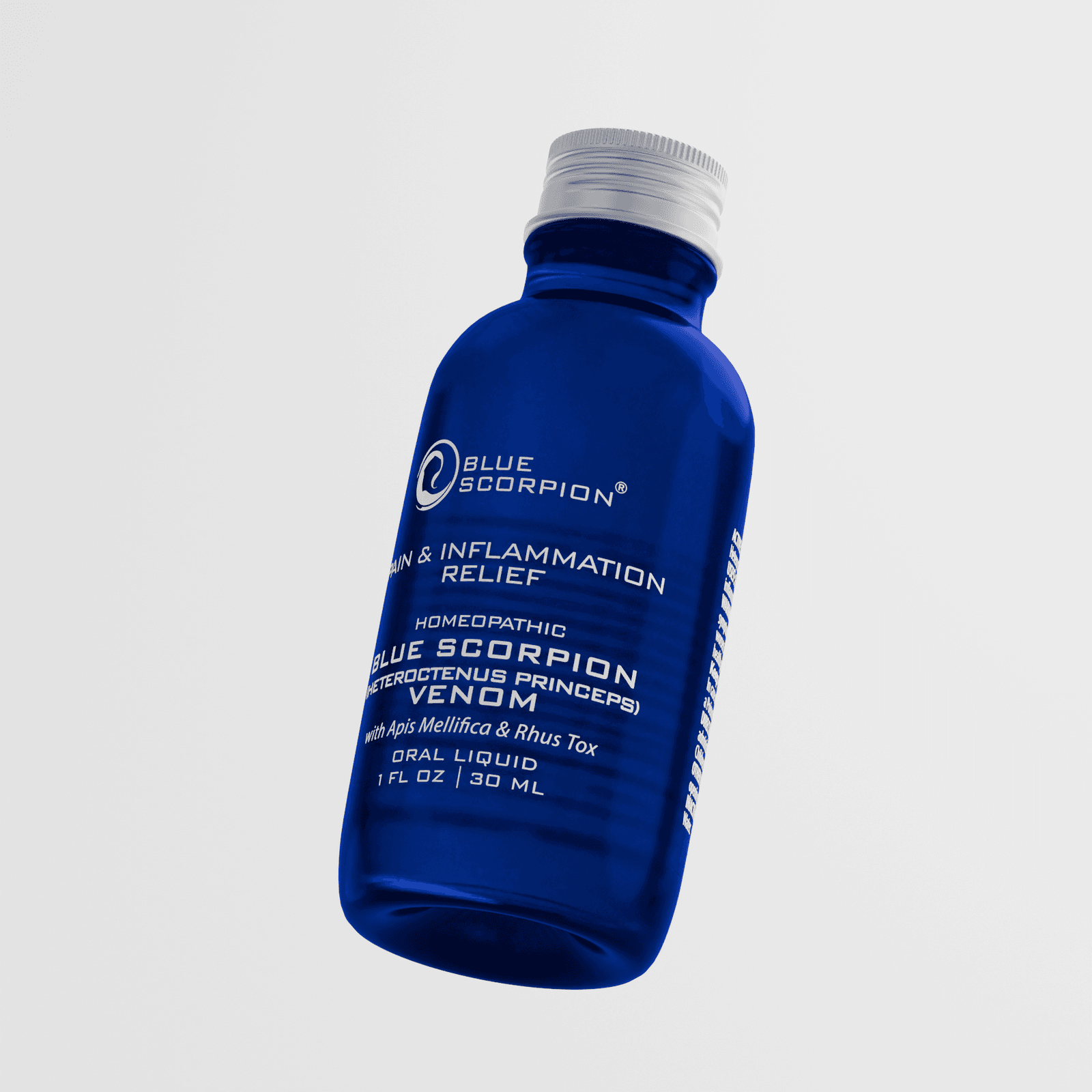
Blue Scorpion Pain and Inflammation Relief is a specific, commercially available homeopathic product that illustrates how these regulatory and formulation principles apply in practice. It is traditionally used for the temporary relief of minor aches and discomfort.
What Blue Scorpion Contains and How It Is Taken
Blue Scorpion contains three active ingredients:
Heteroctenus Princeps venom 3X sourced from the Caribbean Blue Scorpion in the Dominican Republic
Apis Mellifica 6X derived from the honeybee
Rhus Toxicodendron 6X, derived from poison ivy
The inactive ingredients are citric acid and distilled water. The product is taken sublingually, meaning you hold it under the tongue for 15 seconds before swallowing. The standard adult dose is 2 ml in the morning and 2 ml in the evening. It is non-opioid and alcohol-free. It is listed with the FDA under NDC 83627-901-01 and NDC 83627-901-02.
Why Some Readers Look for a Sublingual Format
Sublingual administration delivers the liquid directly through the tissue under the tongue rather than via topical application or prior digestion. Some people prefer this format because it involves no mess, no scent, and no reapplication to the skin. It also fits easily into a morning and evening routine.
Credibility Points to Evaluate Before You Buy
When evaluating any homeopathic OTC product, look for:
An NDC number on the label
A cGMP-certified manufacturing facility
Clear ingredient listing with potency markers
Third-party testing for banned substances if athletic use is relevant
Honest benefit language that does not overclaim
Blue Scorpion meets these criteria: it is manufactured in a cGMP facility, is tested against 400-plus banned substances in ISO 17025-accredited labs, and carries the NDC numbers noted above.
When to Get Medical Advice and How to Read Claims Carefully
Homeopathic options are best considered as one part of a thoughtful, informed approach to daily well-being. This does not mean avoiding professional care when it is genuinely needed.
Signs Discomfort Needs Professional Evaluation
Seek medical attention if your discomfort:
Appeared suddenly and is severe
Is accompanied by fever, numbness, or loss of function
Has been present for more than a few weeks without a clear cause
Is worsening rather than staying stable or improving
Follows an injury that may involve a fracture or significant tissue damage
Homeopathic OTC products are intended for temporary relief of minor discomfort. They are not a substitute for diagnosis or treatment of any underlying condition.
Questions to Ask Before Trying Any OTC Option
Before you purchase any homeopathic product, ask yourself:
Does the label carry an NDC number?
Does the manufacturer clearly disclose ingredients and dilution levels?
Is the benefit language realistic and appropriately qualified?
Has the product been tested for purity and banned substance content?
Does the label include the required FDA disclaimer?
These questions apply equally to any homeopathic medicine. The answers tell you a great deal about whether a brand operates with honesty.
Frequently Asked Questions
Stiff, Achy Joints: Which Homeopathic Remedy Is Traditionally Referenced for Discomfort That Loosens With Movement?
Rhus Toxicodendron is among the most commonly referenced remedies in traditional homeopathic materia medica for stiffness that eases as the body warms up and moves. This is a traditional pattern-matching reference, not a treatment recommendation for any diagnosed joint condition — anyone with ongoing or worsening joint symptoms should talk with a healthcare provider.
Muscle Strain Discomfort: What Homeopathic Remedy Is Commonly Referenced for Sore, Overworked Muscles?
Arnica Montana is the most widely cited remedy in homeopathic literature for soreness, bruising, and the aching that follows overexertion or physical strain.
Back Discomfort: Which Homeopathic Remedy Is Often Referenced When Sensations Feel Worse After Lifting or Bending?
Bryonia Alba is commonly noted in the homeopathic materia medica for discomfort aggravated by movement, including bending and lifting, and relieved by rest and firm pressure. Rhus Toxicodendron is referenced when discomfort is stiff on first movement but loosens with continued activity.
Hot, Puffy Sensations: What Homeopathic Remedy Is Commonly Referenced for Tissue That Feels Warm and Swollen?
Apis Mellifica is the remedy most often referenced in traditional materia medica for tissue that feels hot, swollen, and puffy with a stinging quality. It is derived from the honeybee. This is a traditional-use reference for general sensation patterns, not a claim about any specific inflammatory condition.
Minor Bruising Discomfort: How Is Arnica Montana Typically Used in Homeopathy for Tenderness After a Bump or Fall?
Arnica Montana is traditionally used orally in homeopathic form for the temporary relief of minor soreness and bruising after impact or a fall. It is one of the most recognized remedies in the homeopathic system for acute soft-tissue discomfort. Standard OTC products containing Arnica Montana provide dosing instructions on the label.
Putting It Into Practice
Matching a remedy to how discomfort actually feels (not just what it's called) is the core idea behind everything in this guide. A basic natural support plan might combine rest, gentle movement, attention to sleep quality, and a homeopathic OTC product used consistently rather than only reached for in the moment.
If you want to see what that looks like in an actual product (clearly labeled, FDA NDC listed, and upfront about what its claims are and aren't based on), Blue Scorpion is worth a look. It's traditionally used for the temporary relief of minor aches and discomfort in general, and it's built around the same honest-labeling standard this guide walks through.
Pair any homeopathic routine with realistic expectations, and with professional guidance for anything beyond minor, familiar discomfort.
These statements are based on traditional homeopathic practice, which is not accepted by most modern medical experts, and have not been evaluated by the Food and Drug Administration. There is no scientific evidence that this product works. This product is intended for the temporary relief of symptoms. Individual results may vary.