

Many people assume "FDA listed" means the same thing as "FDA approved." It does not. These two phrases describe very different regulatory statuses, and confusing them can lead you to misread what a product label actually tells you about safety and oversight.
This article explains what a National Drug Code is, what FDA listing actually covers, and how that differs from FDA approval. It also explains why no homeopathic product holds FDA approval, using Blue Scorpion's own listing as a plain, real-world example.
If you have ever seen an NDC number on a label and wondered what it means, this is a clear breakdown. Discover Blue Scorpion to see what a transparent, FDA NDC-listed homeopathic option looks like.
What an NDC Number Is
A National Drug Code is a unique product identifier assigned to drugs marketed in the United States. Every NDC carries specific information about the product, the manufacturer, and the packaging format.
How National Drug Codes Identify Marketed Drug Products
An NDC is a 10-digit or 11-digit number structured in three segments. The first segment identifies the labeler, meaning the manufacturer or distributor. The second identifies the specific product. The third identifies the package size and type.
Under 21 CFR Part 207, the FDA assigns an NDC when a manufacturer submits required listing information for a drug product. The NDC then appears in the FDA's National Drug Code Directory, which is updated daily.
NDC Segment | What It Identifies |
First (Labeler Code) | Manufacturer or distributor |
Second (Product Code) | Specific drug formulation |
Third (Package Code) | Package size and type |
The NDC is not a stamp of approval. It is a tracking and identification system. A product can carry a valid NDC and still not be FDA approved.
Why Consumers See NDC Numbers on Labels and Listings
You will find NDC numbers on OTC drug labels, prescription bottles, and homeopathic products. They appear because federal law requires marketed drug products to carry them. Seeing an NDC tells you the manufacturer has registered with the FDA and submitted listing information. It does not tell you the FDA has reviewed or approved the product's formula.
The FDA has clearly stated that having an NDC number does not mean a product is FDA-approved, FDA-verified, or covered by insurance.
What FDA Listing Covers
FDA listing is a registration and compliance process. It establishes that a manufacturer is operating within certain documented standards before a product reaches shelves.
Facility Registration and Product Submission
To market a drug product in the United States, a manufacturer must register its facility with the FDA and submit product listing information. This includes details about the product's formulation, labeling, and the facility where it is made. The FDA uses this information to maintain oversight of what is being marketed and where it is being made.
Registration and listing create a paper trail. They give the FDA the ability to monitor the market and take enforcement action when needed. They do not require the FDA to review or evaluate whether the product actually works.
Labeling and Manufacturing Compliance Basics
A listed drug product must comply with FDA labeling rules. That includes accurate ingredient disclosures, dosage directions, and required warnings. Manufacturers are also expected to follow current Good Manufacturing Practice (cGMP), which sets standards for facility cleanliness, quality control, and consistency.
These requirements are meaningful. They separate listed products from completely unregistered products, which carry no oversight at all. A product made in a cGMP-certified facility under FDA listing is held to documented standards. An unregistered research chemical sold online is not.
What Approval Involves
FDA approval is a separate process that requires the agency to actively evaluate clinical evidence. Listing and approval are not two levels of the same thing. They are different processes with different outcomes.
FDA Review of Safety and Effectiveness Evidence
For a product to receive FDA approval, the manufacturer must submit clinical evidence showing the product is safe and effective for its intended use. The FDA reviews trial data, manufacturing controls, and proposed labeling before granting approval. This process applies to prescription drugs through the New Drug Application pathway and to biologics through the Biologics License Application pathway.
High-risk medical devices go through Premarket Approval, which also requires clinical data. Lower-risk devices may go through a different pathway called 510(k) clearance, which is not the same as approval but still requires FDA review of the submission.
Why Listing and Approval Are Not Interchangeable
A listing tells you that a product has been registered and follows labeling rules. Approval means the FDA has reviewed the evidence and determined the product is safe and effective for specific uses. You cannot substitute one for the other when evaluating a product's regulatory standing.
A product can be listed without ever being approved. A product can carry a valid NDC without the FDA having evaluated a single clinical study about it. When you see "FDA listed" on a label, that is not shorthand for "FDA tested and verified."
How Homeopathic Products Fit
Homeopathic medicines occupy a specific place in FDA regulation. They are classified as drugs under the Federal Food, Drug, and Cosmetic Act, but they follow a different path than conventional pharmaceuticals.
Why Homeopathic Medicines Are Not FDA Approved
The FDA has stated directly that there are no FDA-approved products labeled as homeopathic in the United States. Homeopathic products were not required to go through the same premarket approval process as conventional drugs when the regulatory framework was established. As a result, many homeopathic products entered the market without clinical review.
The FDA's guidance on homeopathic drug products made clear that the agency cannot ensure these drugs meet standards for safety, effectiveness, and quality in the same way it can for approved products. Homeopathic products marketed legally are expected to comply with FDA labeling rules and manufacturing standards, but they do not carry approval status.
What FDA NDC Listed Means for a Homeopathic Product
An FDA NDC-listed homeopathic product is registered with the FDA, carries a unique product identifier, and must comply with federal labeling and manufacturing rules. That is a real and meaningful baseline. It distinguishes a listed homeopathic product from an unregistered compound sold in the gray market with no oversight.
It does not mean the FDA has reviewed the product's formula or confirmed it works. Benefit claims for homeopathic products are based on traditional homeopathic practice, not on FDA-evaluated clinical data.
How to Evaluate a Product Before You Buy
Knowing the difference between listing and approval gives you a framework for making smarter choices. A few specific checks help you go beyond the label.
Checking NDC Status and Label Transparency
Start by looking for an NDC number on the label. You can verify the number in the FDA's National Drug Code Directory at no cost. A valid NDC confirms that the product is registered and that the manufacturer has submitted the required listing information. If a product makes drug-like claims but carries no NDC and no registration, that is a significant red flag.
Look also at the ingredient label. A transparent product lists active ingredients with their dilution levels, along with inactive ingredients. Incomplete or vague labeling is a warning sign regardless of any regulatory claim on the packaging.
Looking for cGMP Manufacturing and Independent Testing
cGMP certification means the facility follows documented standards for manufacturing quality and consistency. This matters because it reduces the risk of contamination, mislabeling, and inconsistent potency. A product made in a cGMP-compliant facility carries more accountability than one made in an unregulated environment.
Independent third-party testing adds another layer of verification. Look for testing performed in ISO 17025-accredited laboratories. This standard confirms the lab meets international requirements for testing competence. For athletes or anyone subject to drug testing, look for certification against a panel of banned substances.
Verify the NDC number in the FDA's public database
Confirm the facility holds cGMP certification
Look for third-party testing by an ISO 17025-accredited lab
Check whether the product has been tested for banned substances
Read the full ingredient label, including dilution levels
Review labeling for required warnings and usage directions
Frequently Asked Questions
What Does It Mean When a Device Is FDA Cleared Instead of Approved?
FDA clearance applies to lower-risk medical devices, typically Class I and Class II. Clearance means the FDA reviewed a 510(k) submission and determined the device is substantially equivalent to a legally marketed predicate device. It is not the same as approval, which requires clinical evidence of safety and effectiveness.
How Can You Check Whether a Product Has an FDA Clearance or Approval?
You can search the FDA's Drugs@FDA database for drug approvals and the FDA's 510(k) and PMA databases for medical device clearances and approvals. For NDC-listed drug products, the FDA's National Drug Code Directory is publicly searchable and updated daily.
What Is the Difference Between FDA Registered and FDA Cleared for Medical Devices?
FDA-registered means a facility or establishment has submitted the required registration information to the FDA. FDA-cleared means a specific device has undergone the 510(k) review process and been found substantially equivalent to a predicate device. Registration is a facility-level status. Clearance is a product-level status.
Why Are Some Drugs Sold in the U.S. Not FDA Approved?
Certain drug categories, including OTC homeopathic products, entered the market under regulatory frameworks that did not require premarket approval. They are subject to FDA labeling and manufacturing rules, but the FDA has not reviewed clinical evidence for their effectiveness. The FDA's 2022 guidance on homeopathic drug products acknowledged this gap directly.
Which FDA Pathway Applies to Red Light Therapy Devices, and What Should Buyers Look for?
Most consumer red light therapy devices are classified as lower-risk devices and may be subject to 510(k) clearance or exemption, depending on their intended use and classification. Buyers should look for a valid 510(k) number or device listing in the FDA's database, along with cGMP manufacturing and third-party safety testing.
What Does an FDA NDC Listing Number Confirm About an Over-the-Counter Product?
An NDC listing number confirms the manufacturer has registered with the FDA, submitted required product information, and is marketing the product under federal labeling rules. It confirms the product is in the FDA's National Drug Code Directory. It does not confirm the FDA has reviewed or approved the product's formula for safety or effectiveness.
Where Blue Scorpion Fits: Listed, Not Approved
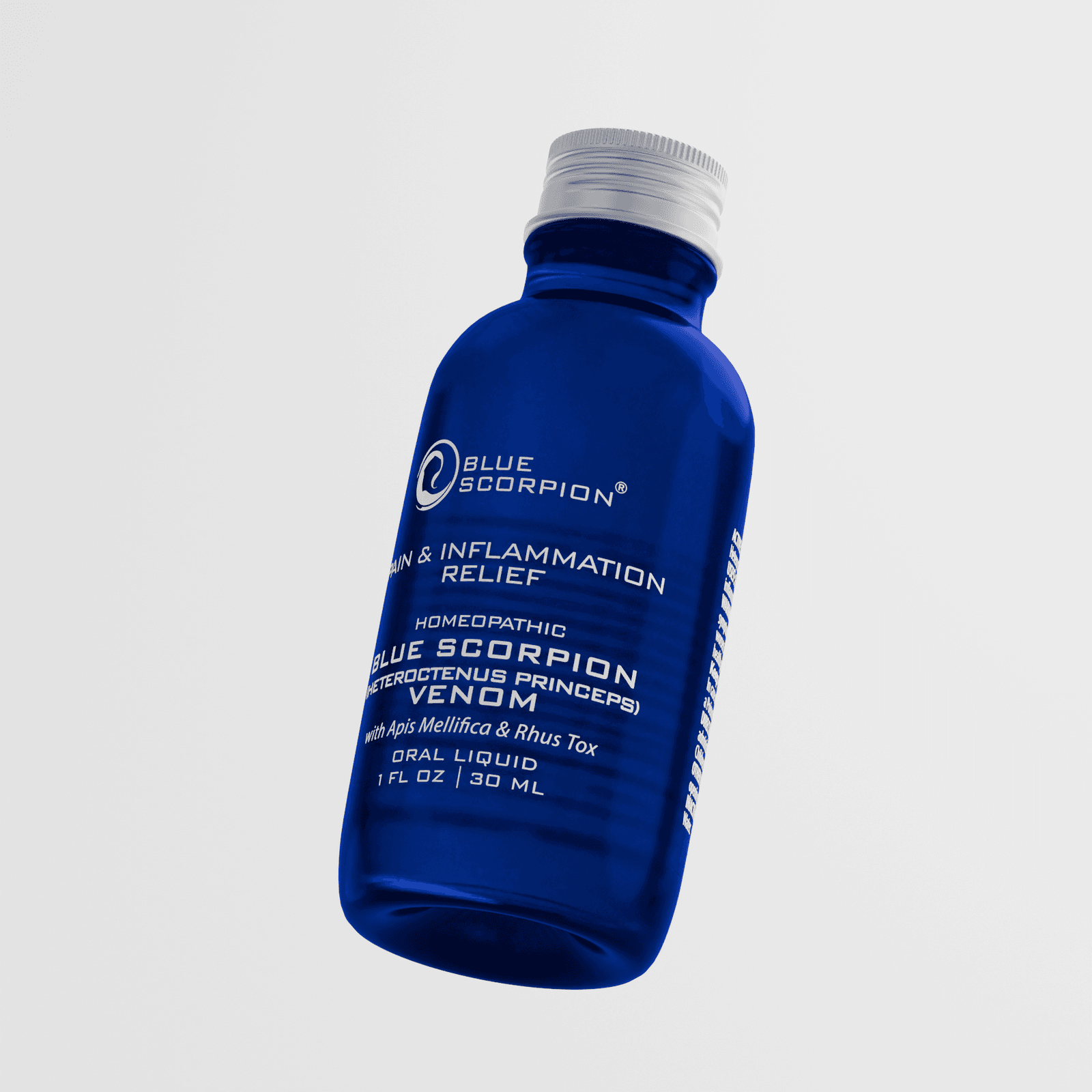
Blue Scorpion Pain and Inflammation Relief is listed with the FDA under NDC 83627-901-01 and NDC 83627-901-02. It is manufactured in an FDA-registered, cGMP-certified facility. It is tested against more than 400 banned substances in ISO 17025-accredited, WADA-based laboratories and carries TruShield certification for sport.
The formula contains Heteroctenus Princeps venom 3X, Apis Mellifica 6X, and Rhus Toxicodendron 6X. Caribbean Blue Scorpion venom is the source material, which undergoes serial dilution to homeopathic potency before it becomes the finished product
Blue Scorpion is not FDA-approved. No homeopathic product is. Its listing under two active NDC numbers means it is a registered, labeled, and manufactured drug product held to federal standards, which puts it in a very different category from unregistered research chemicals that carry no NDC, no facility oversight, and no third-party testing.
Benefit language for Blue Scorpion is limited to the level permitted by the homeopathic labeling standard: traditionally used for the temporary relief of minor aches and discomfort.*
Check the label. Check the NDC. Then check out Blue Scorpion.
*These statements are based on traditional homeopathic practice, which is not accepted by most modern medical experts, and have not been evaluated by the Food and Drug Administration. There is no scientific evidence that this product works. This product is intended for the temporary relief of symptoms. Individual results may vary.

