

Your tongue rests under a small dropper of liquid, and you wait. Fifteen seconds feels longer than it sounds when you're standing in your kitchen at 7 a.m., bottle in hand, trying to figure out if you're doing this right.
That waiting is the whole point of a sublingual liquid. It's a delivery method, not a promise about how a remedy works once it's in your body. Homeopathic liquids get held under the tongue instead of swallowed with water, chewed, or dissolved slowly like a pellet.
If you're comparing liquid homeopathic pain formulas, the format details that actually matter are potency labels like 3X or 6X, whether the bottle contains alcohol, and whether the directions match a dose you can realistically follow every day. Marketing language about "fast acting" or "quantum enhanced" tells you nothing about whether a formula fits your routine.
By the end of this piece, you'll know how sublingual liquids work, what the numbers and letters on a label actually mean, how to match a formula type to your symptoms, and when a liquid homeopathic product isn't the right tool for what you're dealing with.
How Do Sublingual Liquid Formulas Work?
Sublingual liquids are absorbed through the mouth instead of the stomach, at least in theory. The tissue under your tongue is thin and full of small blood vessels, which is why dentists numb it before dental work and why some medications are designed to dissolve there instead of being swallowed.
What Taking Drops Under the Tongue Means
Taking a liquid sublingually means placing drops under your tongue and holding them there, usually for a set number of seconds, before swallowing. You don't chew it, swish it, or wash it down with water right away.
Most sublingual liquid directions ask you to hold the dose for 15 to 30 seconds. This gives the liquid time to sit against the tissue instead of getting swallowed immediately.
Why Some People Prefer a Liquid Over Tablets or Pellets
Liquids skip the need to let a tablet or pellet dissolve slowly, which some people find easier to fit into a routine, especially with meals. A dropper also makes it simple to adjust the amount you take within the labeled range, since homeopathic remedies can come as pellets, tablets, or liquid drops, each with its own handling.
A liquid bottle travels easily and doesn't require water, which matters if you're dosing before a meal or while traveling. None of this changes what's inside the bottle. It's a convenience difference, not a strength difference.
What Sublingual Use Can and Cannot Tell You About Onset?
Holding a liquid under your tongue does not tell you how quickly a homeopathic remedy will act, because homeopathic dilution and delivery route are two separate questions. Some people prefer sublingual formats simply for convenience and ease of dosing, not because the format itself has been shown to work faster for a diluted remedy.
Be cautious of any product that pairs sublingual delivery with a speed claim. The route describes where the liquid goes, not how fast it works.
What Should You Check on the Label?
Check the potency numbers, the ingredient list, the alcohol content, and the dosing directions before buying any liquid homeopathic pain formula. These four details tell you more about a bottle than any front-label claim.
Potency and Dilution Labels Such as 3X and 6X
The letter and number after an ingredient name (like 3X or 6X) describe how many times that ingredient was diluted, following a fixed ratio repeated at each step. Homeopathic dilution follows set mathematical ratios, with each round of dilution and shaking called a "potency."
An X potency means a 1:10 dilution ratio repeated that many times. A 6X ingredient has gone through six rounds of 1:10 dilution, meaning very little of the original substance is measurably left in the final liquid.
Single Remedies vs. Combination Formulas
A single-remedy formula contains one homeopathic ingredient, while a combination formula blends several, each traditionally associated with a different symptom pattern. Combination remedies aren't new; manufacturers have blended single remedies into multi-ingredient formulas since the early 1800s.
Combination formulas are common in over-the-counter liquid drops because they cover more ground at once. Reading the ingredient panel tells you whether you're getting one active ingredient or a blend of three or four.
Alcohol Content, Inactive Ingredients, and Storage
Some liquid homeopathic remedies use an alcohol base instead of water, and this shows up in the inactive ingredients list. Whether a liquid uses a water base or an alcohol base is a manufacturing choice, so check the label directly if you're avoiding alcohol for any reason rather than assuming either way.
Storage instructions matter too. Some liquids need refrigeration after opening, while others just need a cool, dark spot away from sunlight. Check both the inactive ingredients and the storage line before you buy.
Serving Size, Dropper Markings, and Daily Directions
The directions panel tells you how many milliliters to take, how often, and whether that changes by age group. A typical liquid drop format might direct 2 mL twice a day for adults, with a lower amount and different instructions for children.
Look for a maximum daily amount listed on the label, not just a single dose. That number tells you the ceiling, not just the starting point.
Which Formula Type Fits Your Symptoms and Routine?
Match the formula to the symptom pattern first, then to how often you're willing to take it. Homeopathic pain products aren't interchangeable just because they share a liquid format.
Formulas for Occasional Muscle Soreness and Stiffness
Formulas aimed at occasional soreness, the kind from overexertion or a hard workout, often list ingredients traditionally tied to short-term muscular discomfort. Labels in this category are usually narrower than an all-purpose pain formula, specifying something closer to temporary relief of minor aches from overexertion, fatigue, or a passing illness.
These statements are based only on traditional homeopathic theory from the 1700s and are not accepted by most modern medical experts. No scientific evidence shows this product works.These statements are based only on traditional homeopathic theory from the 1700s that is not accepted by most modern medical experts, and there is no scientific evidence that the product works. Blue Scorpion is a homeopathic medicine and is not FDA approved.
If your soreness shows up after activity and fades within a day or two, it may fit this category. If it's constant, that points toward a different formula type, and possibly a conversation with a doctor.
Traditional Homeopathic Profiles for Nerve and Joint Discomfort
Certain homeopathic ingredients have a long traditional association with nerve irritation, joint stiffness, or bruising-type discomfort, regardless of the cause. Rhus Toxicodendron, made from poison ivy, is traditionally associated with joint discomfort, muscle stiffness, and skin irritation.
Apis Mellifica, made from honeybee venom, is traditionally associated with swelling and redness. Our homeopathic pain relief guide covers how each of these ingredients is traditionally used in more depth.
These statements are based only on traditional homeopathic theory from the 1700s, not accepted by most modern medical experts. No scientific evidence shows this product works.These statements are based only on traditional homeopathic theory from the 1700s that is not accepted by most modern medical experts, and there is no scientific evidence that the product works. Blue Scorpion is a homeopathic medicine and is not FDA approved.
If you have a diagnosed joint condition like arthritis, that's a matter for your doctor, not a label-matching exercise. Traditional ingredient profiles describe symptom patterns, not diagnoses.
Short-Term Directions vs. Daily Use Instructions
Some liquid formulas are labeled for short-term or occasional use, while others give daily dosing directions meant to be followed consistently. Read the directions panel closely, because a formula meant for occasional flare-ups will have different guidance than one built around a twice-daily routine.
If your goal is a daily addition to a wellness routine, look specifically for a label that gives a daily maximum and a regular schedule, not just an "as needed" instruction.
How Do Alcohol-Free Combination Drops Compare?
Alcohol-free combination drops differ mainly in ingredient count, source material, and how clearly the manufacturer discloses its registration status. Comparing a few concrete details gets you further than comparing marketing language.
A Three- Active Ingredient Sublingual Formula Example
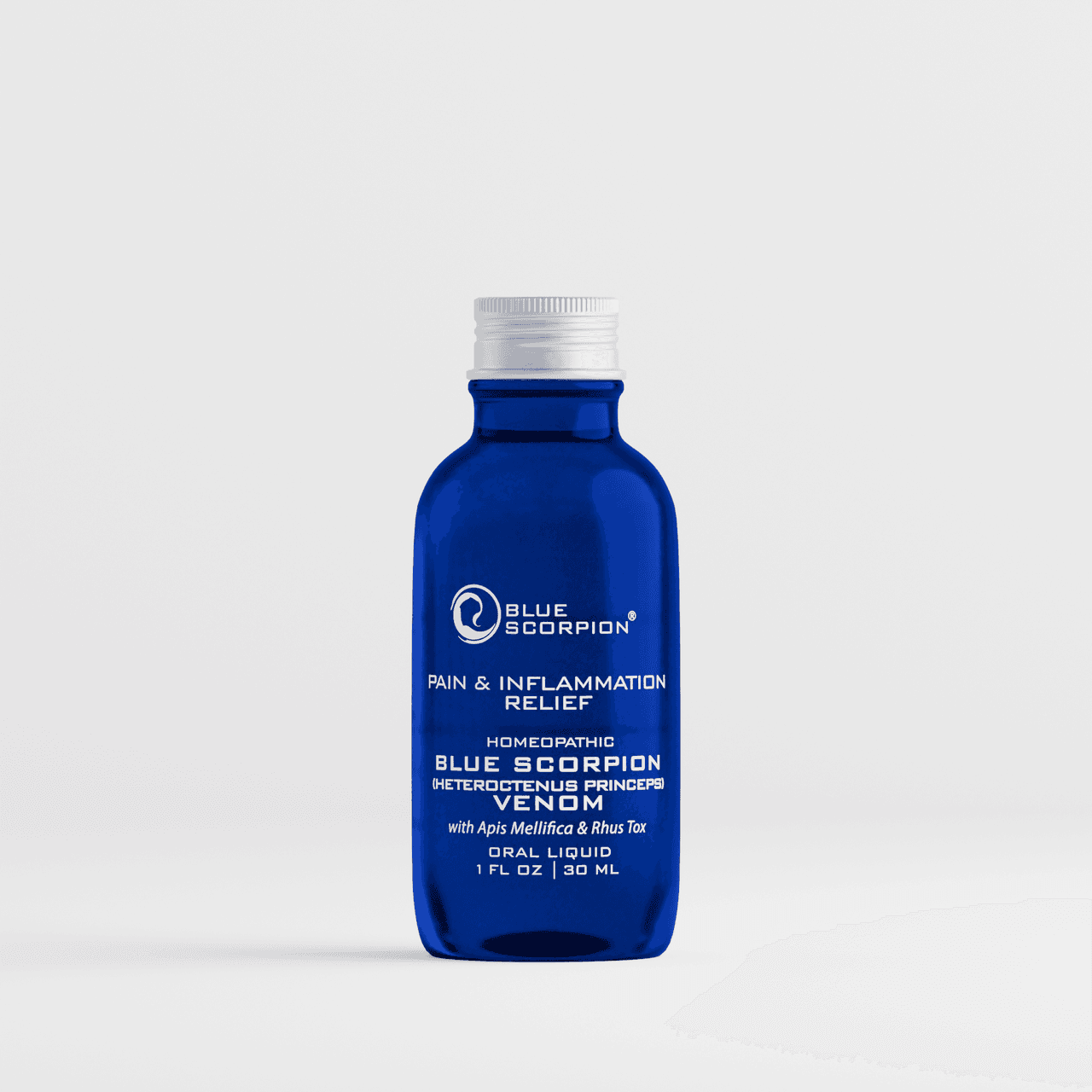
Blue Scorpion Pain & Inflammation Relief is one example of a three-ingredient sublingual liquid: Heteroctenus Princeps Venom 3X, Apis Mellifica 6X, and Rhus Toxicodendron 6X, in a distilled water with no alcohol. The directions call for 2 ml under the tongue, held for 15 seconds, twice daily for adults and children 12 and over, with a lower dose for children 6 to 12 and a doctor's guidance advised for younger children.
These statements are based only on traditional homeopathic theory from the 1700s, which most modern medical experts do not accept. No scientific evidence shows this product works.These statements are based only on traditional homeopathic theory from the 1700s that is not accepted by most modern medical experts, and there is no scientific evidence that the product works. Blue Scorpion is a homeopathic medicine and is not FDA approved.
Comparing a formula like this against a single-ingredient drop mainly comes down to whether you want a broader ingredient blend or a narrower, single-remedy profile.
How to Compare Formula Transparency and FDA NDC Registration
An FDA National Drug Code (NDC) on a homeopathic label means the product is registered with the FDA, not that the agency has evaluated its effectiveness. The FDA regulates homeopathic products under the same misbranding and adulteration rules as other drugs, but that's a labeling and manufacturing standard, not a stamp of effectiveness.
When comparing bottles, check whether the label lists an NDC number at all, and whether the ingredient panel discloses potency (3X, 6X) for each active ingredient. A label that hides potency or lists vague "proprietary blend" language gives you less to work with.
Questions to Ask Before Choosing a Bottle Size or Subscription
Before committing to a bottle size or a subscription plan, ask how many milliliters you'll actually use per month based on the daily directions, and whether the price scales sensibly with that math. A 4 ml daily dose from a 4 oz bottle (about 118 ml) lasts roughly a month, which is worth calculating before buying a larger size out of habit.
Also ask whether the seller accepts HSA or FSA funds, offers installment payment options, and what the return policy says about opened bottles. Liquid homeopathic products are often final sale once shipped, with replacements (not refunds) available only for damaged or incorrect orders within a set window, so read that policy before you buy a large supply.
When Should You Talk With a Healthcare Professional?
Talk to a doctor before self-treating pain that is severe, sudden, worsening, or tied to an injury with visible swelling, loss of function, or numbness. Homeopathic liquids are meant for minor, everyday discomfort, not for pain patterns that need a diagnosis.
Pain Patterns That Need Assessment Instead of Self-Treatment
Pain that wakes you up at night, spreads, or comes with fever, numbness, or weakness needs a doctor's evaluation, not a label comparison. The same goes for pain following a fall, a sports injury with a pop or snap, or joint swelling that doesn't go down within a couple of days.
If you've been managing a diagnosed condition like arthritis with prescribed treatment, that plan stays with your doctor. Homeopathic liquids are not designed to replace it or to manage a diagnosed disease.
Pregnancy, Breastfeeding, Children, and Prescription Medicines
If you're pregnant or breastfeeding, ask a healthcare professional before using any homeopathic liquid product. The same guidance applies to children under the age listed on the label, where many products simply say to ask a doctor first.
Homeopathic products are generally not known to interact with medications, but "generally not known" is not the same as "confirmed safe for you." If you take prescription medicine for an ongoing condition, mention any homeopathic product you're adding to your routine at your next appointment.
How to Use the Product Directions Without Exceeding the Label Dose
Follow the milliliter amount and frequency printed on the label, and don't exceed the stated daily maximum. A typical adult direction reads 2 ml in the morning and 2 ml in the evening, for a total of 4 ml a day, not more.
If a dose doesn't seem to be doing anything for you, don't take more than the label allows. Instead, reassess whether the product fits your situation, and bring that question to a doctor if the discomfort persists.
Frequently Asked Questions
What is the difference between liquid homeopathic drops and pellets?
Liquid drops are taken with a dropper and held under the tongue, while pellets are small sugar globules that dissolve slowly under the tongue. Both formats can contain the same diluted active ingredients; the difference is mainly how you take the dose and how easy it is to adjust the amount.
Are liquid homeopathic pain formulas taken under the tongue?
Yes, most liquid homeopathic pain formulas are meant to be taken sublingually, meaning the drops go under the tongue and are held there for a set number of seconds before swallowing. Directions usually specify a hold time, often 15 to 30 seconds, before you swallow.
What do 3X and 6X mean on a homeopathic label?
The X refers to a 1:10 dilution ratio, and the number tells you how many times that dilution was repeated. A 6X ingredient has been diluted at a 1:10 ratio six times, meaning very little of the original substance remains measurable in the final product.
Do alcohol-free homeopathic liquid formulas exist?
Yes, alcohol-free liquid formulas exist and typically use distilled water as a base and a preservative like citric acid instead of alcohol. Check the inactive ingredients list on any bottle to confirm the base, since some liquid homeopathic remedies use alcohol instead.
Can I use a homeopathic pain formula for arthritis pain?
Homeopathic liquid formulas are not intended to treat or manage arthritis, which is a diagnosed joint condition that needs a doctor's evaluation and treatment plan. If you have arthritis, talk with your doctor about your treatment options rather than relying on an over-the-counter homeopathic product to manage it.
How do I know when pain needs medical attention instead of a homeopathic product?
Pain that is severe, sudden, tied to a visible injury, or comes with swelling, numbness, or fever needs medical attention rather than self-treatment. Pain that persists for weeks, worsens over time, or regularly disrupts your sleep is also a signal to see a doctor rather than keep managing it on your own.
Choosing a Liquid Formula You Can Use as Directed
The practical path here is simple: check the potency labels, confirm there's no alcohol if that matters to you, match the ingredient profile to your actual symptom pattern, and follow the printed dose exactly. Skip past any bottle that hides its potency numbers or gives vague directions.
If your pain is occasional, mild, and tied to normal activity like exercise or a long day on your feet, a liquid homeopathic formula may fit into your routine as one small piece of it. If your pain is severe, sudden, or tied to a diagnosed condition, talk with a doctor before relying on any over-the-counter product, homeopathic or otherwise.
If it fits into your daily routine, Blue Scorpion's FDA NDC-listed, alcohol-free formula is traditionally used for temporary relief of minor aches from everyday exertion.*
Bundle and save on the formula. Shop the full lineup
*These statements are based only on traditional homeopathic theory from the 1700s that is not accepted by most modern medical experts, and there is no scientific evidence that the product works. Blue Scorpion is a homeopathic medicine and is not FDA approved.