

Your shoulders feel tight after a long day at your desk. Your legs ache the morning after a hard workout. Your lower back seizes up after you carry boxes for a few hours. Muscle pain shows up in dozens of small, ordinary ways, and most of the time it has nothing to do with anything serious.
If you're curious about homeopathy for this kind of everyday soreness, you're not alone. Homeopathic medicine for muscular pain matches a remedy to the specific pattern of your discomfort, rather than treating every ache the same way. People seek this approach because they want a system that looks at symptoms differently than a standard pain reliever does.
This guide walks through the common patterns behind muscle pain, how homeopathic remedy matching works, and which traditional remedies show up most often for sore, tight, or overworked muscles. You'll also see where a homeopathic liquid formula might fit into a daily routine, and when it's time to put self-care aside and call a doctor instead.
Common Muscle Pain Patterns and What May Be Behind Them
Most muscle pain falls into a handful of recognizable patterns, and figuring out which one you're dealing with is the first step. The cause usually points to either overuse, poor posture and tension, or something that needs a medical opinion.
Post-Workout Soreness and Overuse Aches
This is the dull, whole-muscle ache that shows up 12 to 24 hours after a hard workout or a physically demanding day. It's often called delayed-onset muscle soreness, and it comes from small amounts of stress on muscle fibers that haven't adapted to a new level of activity yet.
It usually peaks around day two and fades on its own within a few days. Walking, gentle stretching, and staying hydrated tend to help it resolve faster than sitting still.
Tight Muscles From Repetitive Movement or Tension
This pattern feels different: a knot or band of tightness in one specific spot, often in the neck, shoulders, or lower back. It builds gradually from repetitive movement, poor posture, or stress rather than a single hard workout.
Sitting at a desk for hours, gripping a steering wheel, or carrying a bag on one shoulder can trigger it. The pain tends to stay localized instead of spreading through a whole muscle group.
When Muscle Pain May Need Medical Attention
See a doctor if muscle pain comes with swelling, redness, fever, or if it follows an injury with a popping or tearing sensation. These signs can point to something beyond ordinary soreness, like a muscle tear, infection, or a clotting issue that needs prompt evaluation.
Also get checked if pain doesn't improve after a week of rest, if it's severe enough to limit basic movement, or if it comes with numbness or weakness in a limb. Pain that keeps getting worse instead of better is never something to wait out.
How Homeopathic Remedy Matching Works
Homeopathic remedy selection matches the specific character of your pain, not just the body part involved. Two people with sore muscles might get pointed toward completely different remedies depending on what makes their pain better or worse.
Why Pain That Improves With Movement Is Considered Differently
In traditional homeopathic practice, pain that eases once you start moving is treated as a different pattern than pain that worsens with movement. This distinction shapes which remedy gets considered first.
Stiffness that's worst first thing in the morning and loosens as you move points in one direction. Pain that gets sharper the more you use the muscle points in another direction.
Blue Scorpion Pain & Inflammation Relief is a homeopathic medicine. These statements are based on traditional homeopathic practice, not accepted medical evidence, and are not FDA evaluated. This product is intended for the temporary relief of pain, inflammation, and symptoms. It is not intended to diagnose, treat, cure, or prevent any disease. Individual results may vary.
Why Location, Sensation, and Triggers Matter
Homeopathic practitioners look closely at where the pain sits, what it feels like, and what brings it on. A bruised, achy soreness after exertion is treated differently than sharp pain that worsens with the first movement, which differs again from stiffness tied to cold or damp weather.
Musculoskeletal complaints are among the most common reasons people seek out homeopathic treatment in the first place, according to an overview of homeopathy for musculoskeletal health, largely because the patterns are so distinctive from one person to the next.
What Homeopathic Potencies and Dilutions Mean
A potency like 6X or 3X refers to how many times a substance has been diluted and shaken during preparation, following homeopathic pharmacy methods. Together, the number and letter describe the dilution scale and how many rounds of dilution occurred, not a strength in the way a medication dose works.
These numbers appear on ingredient labels so you can see exactly how a remedy was prepared. Understanding them helps you read a label accurately, though it doesn't tell you whether the remedy will do anything for your specific pain.
Traditional Homeopathic Options for Muscle Discomfort
A handful of remedies come up again and again in homeopathic literature on muscle pain, each tied to a specific type of discomfort. Knowing each remedy's traditional profile helps you understand why a combination formula might include more than one.
Arnica Montana for Bruised or Overworked Muscle Soreness
Arnica Montana is one of the most commonly discussed remedies for the bruised, overworked feeling that follows a hard workout or physical strain. It's traditionally associated with soreness that feels like the muscle has been beaten or overused.
Rhus Toxicodendron for Stiffness After Rest
Rhus Toxicodendron, made from poison ivy, is traditionally used for stiffness that's worse after sitting or lying still and improves once you start moving. This pattern, sometimes called "rusty gate" stiffness, is a classic marker practitioners look for when considering this remedy.
Ruta Graveolens for Repetitive Strain and Tendon-Area Discomfort
Ruta Graveolens shows up in traditional homeopathic use for discomfort tied to repetitive strain, especially around tendons and connective tissue. It's often mentioned alongside Rhus Toxicodendron for overuse-type discomfort from repeated motion rather than a single injury.
Bryonia Alba When Movement Makes Pain Worse
Bryonia Alba is traditionally considered for pain that worsens with movement and eases with stillness, the opposite pattern from Rhus Toxicodendron. This remedy often appears in comparisons of pain remedies because it represents this contrasting pattern.
Blue Scorpion Pain & Inflammation Relief is a homeopathic medicine. These statements are based on traditional homeopathic practice, not accepted medical evidence, and are not FDA evaluated. This product is intended for the temporary relief of pain, inflammation, and symptoms. It is not intended to diagnose, treat, cure, or prevent any disease. Individual results may vary.
Choosing a Homeopathic Formula for Everyday Aches
You can choose between a single remedy matched precisely to your symptom pattern or a combination formula that blends a few remedies for broader, everyday support. Each approach fits different needs.
Single Remedies vs. Combination Formulas
A single remedy works best when your pain pattern clearly matches one profile, like stiffness that improves with movement. A combination formula blends multiple remedies to address a range of everyday symptoms without requiring you to pinpoint one exact match first.
Keeping a few single remedies on hand is one approach if you prefer to match a remedy to the day's specific symptoms. A combination formula is another approach, covering a broader symptom range in one bottle.
Reading Labels, Directions, and Age Guidance
Every homeopathic label should list active ingredients with their potency, directions for use, and age-specific dosing. Look for clear guidance on how much to take, how often, and whether children need a different amount or a doctor's input first.
Storage instructions matter too. Many liquid formulas need to be kept at room temperature and refrigerated once opened, and labels should state that clearly.
An Oral Liquid Combination Example
Liquid combination formulas are typically taken under the tongue, or sublingually, rather than swallowed as a pill. This route is common in homeopathic products because it lets the liquid stay in the mouth briefly before swallowing, following the dosing pattern printed on the label.
Some formulas combine two or three ingredients so one bottle covers a wider range of everyday muscle and joint symptoms instead of requiring separate remedies for each.
Our homeopathic pain relief guide covers how ingredient combinations like this are traditionally put together.
What to Know About Blue Scorpion Pain & Inflammation Relief
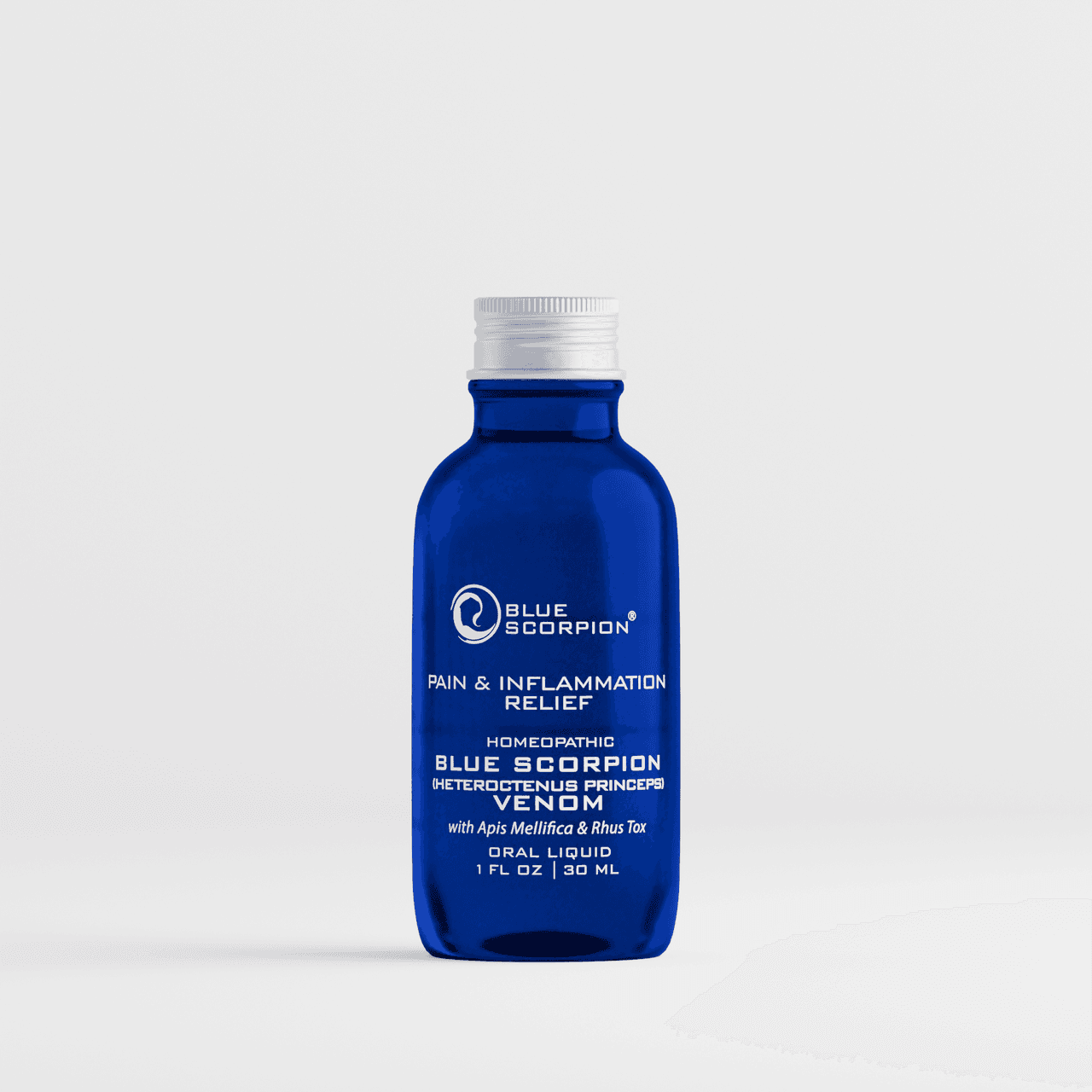
Blue Scorpion Pain & Inflammation Relief is a homeopathic liquid that combines Heteroctenus Princeps Venom 3X, Apis Mellifica 6X, and Rhus Toxicodendron 6X. Take it under the tongue, hold for 15 seconds, then swallow; adult dosing is 2 mL twice daily.
The formula is FDA NDC-listed, meaning it's registered with the FDA's National Drug Code directory. That registration reflects manufacturing and listing requirements, not a government review of whether the product works.
Blue Scorpion Pain & Inflammation Relief is a homeopathic medicine. These statements are based on traditional homeopathic practice, not accepted medical evidence, and are not FDA evaluated. This product is intended for the temporary relief of pain, inflammation, and symptoms. It is not intended to diagnose, treat, cure, or prevent any disease. Individual results may vary.
A Practical Plan for Managing Everyday Muscle Pain
The most useful approach pairs any remedy choice with basic physical care and draws a clear line for when to stop self-managing and get evaluated. Neither piece works well without the other.
Pairing Remedy Choices With Rest, Gentle Movement, and Hydration
Rest, hydration, and gentle stretching are the baseline for recovering from ordinary muscle soreness. A remedy choice sits on top of these basics, not in place of them.
Light walking and drinking water support the body's recovery process after strain. Complete inactivity for days at a time can actually slow recovery down for ordinary soreness.
When Persistent Pain Should Be Evaluated
Pain lasting longer than one to two weeks despite rest, or pain that keeps you from normal daily movement, needs a doctor's evaluation rather than continued self-care. This is worth repeating here because it's easy to keep trying home remedies past the point where a checkup makes more sense.
Fever, significant swelling, or pain following a specific injury with a popping sound are also reasons to stop and get checked rather than wait it out.
Using Homeopathic Products as Directed
Follow label directions exactly, including dosing by age and any guidance to consult a doctor for children under a certain age or for pregnant or breastfeeding women. Homeopathic products generally don't interact with medications when used as directed, but anyone on prescription medication or managing a specific condition should check with a healthcare provider first.
Consistency in timing, like taking a dose before meals, is part of how these products are meant to be used day to day.
Frequently Asked Questions
What is the best homeopathic medicine for muscle pain?
There's no single best remedy because homeopathic selection depends on your specific pain pattern. Arnica Montana is commonly discussed for bruised, overworked soreness, while Rhus Toxicodendron and Bryonia Alba are matched to stiffness or movement-related pain instead.
Does arnica work for post-workout muscle soreness?
Arnica Montana is traditionally used for the bruised, achy feeling that follows hard exercise or physical exertion. These statements are based only on traditional homeopathic theory from the 1700s that is not accepted by most modern medical experts.
When is Rhus Toxicodendron traditionally used for muscle pain?
Rhus Toxicodendron is traditionally associated with stiffness that's worse after rest and improves with movement, sometimes called "rusty gate" stiffness.
Can I use homeopathic medicine for muscle and joint discomfort together?
Combination formulas often address muscle and joint discomfort in one product, since the two frequently overlap in everyday aches. Check the label for the specific ingredients and dosing directions, and talk to a doctor if you're managing a diagnosed joint condition.
How long should muscular pain last before I see a doctor?
Ordinary muscle soreness should start improving within a few days and largely resolve within a week or two. If pain persists longer than that, worsens, or comes with swelling, fever, or numbness, it's time to see a doctor rather than continue self-care.
Matching Your Approach to the Muscle Pain Pattern
The right approach depends on matching what you're feeling to the right care category, not on picking a single "best" remedy. Post-workout soreness that eases with movement and light activity fits self-care and traditional remedies like Arnica Montana. Stiffness that's worse after sitting still fits the Rhus Toxicodendron pattern. Pain that worsens with movement and improves with rest fits the Bryonia Alba pattern instead.
Any pain that comes with swelling, fever, numbness, or that doesn't improve after a week or two belongs with a doctor, regardless of which homeopathic pattern it resembles. Matching the pattern correctly helps you choose a remedy, but it never replaces that basic safety check.
If a combination formula fits your routine, Blue Scorpion's FDA NDC-listed, alcohol-free formula is traditionally used for temporary relief of minor muscle and joint discomfort.*
Bundle and save on the formula.
Shop the full lineup
Blue Scorpion Pain & Inflammation Relief is a homeopathic medicine. These statements are based on traditional homeopathic practice, not accepted medical evidence, and are not FDA evaluated. This product is intended for the temporary relief of pain, inflammation, and symptoms. It is not intended to diagnose, treat, cure, or prevent any disease. Individual results may vary.